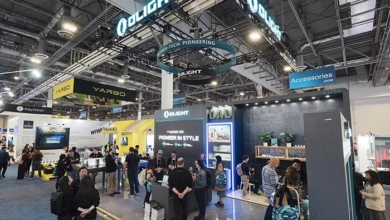

Bright Ideas: Smart, Stylish, Connected Lighting
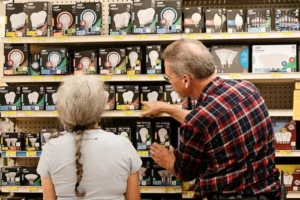
Lighting has long been a core hardware category, but today’s aisle bears surprisingly little resemblance to that of a decade ago. Advances in LED technology, the growth of smart-home systems and consumers’ desire to personalize their living spaces have transformed lighting from a replacement purchase into an opportunity for upgrades and project sales.
LEDs continue to dominate the category. Residential LED products use at least 75% less energy and last up to 25 times longer than incandescent bulbs, according to the U.S. Department of Energy’s Energy Saver: LED Lighting guidance, updated this year. The continued migration to LED technology has fundamentally reshaped the market and reduced overall energy consumption, according to the Department of Energy.
The shift has been rapid. By 2024, 63% of U.S. households reported using LEDs for most or all indoor lighting, up from just 4% in 2015, according to the U.S. Energy Information Administration’s 2024 Residential Energy Consumption Survey, published earlier this year. Over the same period, the share of households relying primarily on incandescent or halogen bulbs fell to just 10%, according to the EIA.
LEDs are also becoming the dominant installed technology across homes and businesses. The U.S. Department of Energy’s 2020 U.S. Lighting Market Characterization report, released in 2024, found that LEDs represented roughly 48% of the installed lighting base in residential and commercial buildings. The report further noted that average wattage per installed lighting unit has declined significantly as consumers replace legacy technologies with high-efficiency LED products.
For hardware retailers, this transition creates opportunities beyond simple bulb replacement. Consumers upgrading to LEDs often purchase compatible dimmers, smart controls, fixtures and various electrical accessories, increasing basket size while improving customer satisfaction.
Smart Homes Fuel Lighting Growth
Smart lighting represents one of the category’s fastest-growing segments. The global smart LED lighting market was valued at some $27.3 billion in 2024 and is projected to reach $68.5 billion by 2030, according to Grand View Research’s Smart LED Lighting Market Size & Trends Report, published in 2025.
Researchers attributed much of this growth to increasing smart-home adoption and rising consumer interest in energy management. Connected lighting products continue to evolve as well. Features such as voice control, automated schedules and app-based management have become increasingly common, according to ENERGY STAR’s 2025 Smart Lighting guidance. ENERGY STAR notes that connected lighting systems can reduce energy use by ensuring that lights operate only when needed.
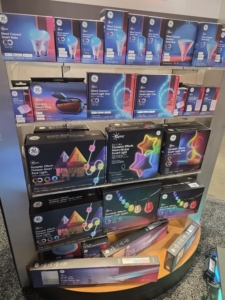
Interoperability is becoming increasingly important as consumers add devices from multiple brands. The adoption of Matter, a universal smart-home connectivity standard developed by the Connectivity Standards Alliance, is helping simplify setup and compatibility between devices, according to the organization’s published standards and industry updates.
Creating Atmosphere Indoors and Out
Lighting is also increasingly viewed as an element of home décor rather than solely a utility purchase. Consumers continue to seek layered lighting designs that combine ambient, task and accent lighting to improve both function and aesthetics, according to design trend reporting from major lighting manufacturers and industry publications during 2025 and 2026.
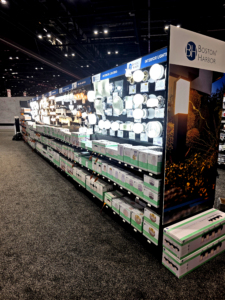
Outdoor lighting remains another growth area. Landscape lighting, pathway fixtures and security lights benefit from the energy efficiency and long life of LED technology. The U.S. Department of Energy’s SSL Forecast Report projects that future energy savings from LED adoption will be driven heavily by commercial, industrial and outdoor lighting applications due to their long operating hours and high light output. Merchandising and education remain critical to category success. Consumers often struggle with concepts such as lumens, color temperature and fixture compatibility. Clear signage and product comparisons can simplify decision making and improve confidence, according to ENERGY STAR guidance for lighting products and retailers.
Ultimately, lighting occupies a unique position within the hardware store. It combines necessity with aspiration, technology with design and replacement purchases with larger projects. As consumers continue to prioritize energy efficiency, connected homes and personalized living spaces, the lighting category appears well positioned for continued growth, according to analyses from the U.S. Department of Energy, the U.S. Energy Information Administration and Grand View Research.
Lighting Displays Inspire Whole-Home Solutions
For many retailers, lighting is lined up, straight shelf and merchandised by category—bulbs in one aisle, fixtures in another. At Rangeley Lakes Builders Supply Co. in Rangeley, Maine, however, lighting is displayed much like furniture: as part of a complete room experience.
“We try to give people inspiration for how they can set things up in their own homes,” says the store’s Virginia Patnode MacFawn.
Rangeley Lakes Builders Supply’s lighting department features furniture-style displays with chandeliers, sconces and table lamps arranged in coordinated settings rather than isolated product groupings. The goal is to help customers visualize how multiple lighting elements work together to create a finished look.
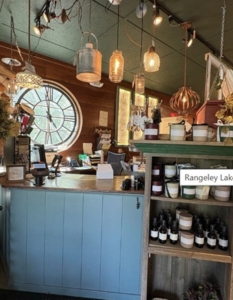
MacFawn says the store emphasizes the importance of layered lighting—combining ambient, task and accent lighting throughout the home. A customer might see a chandelier paired with wall sconces and table lamps to demonstrate how different fixtures complement one another in a space.
Beyond decorative fixtures, the retailer also showcases practical lighting solutions such as recessed lighting and under-cabinet accent lighting. These displays help customers understand how good lighting can enhance both function and atmosphere in kitchens, living areas and other spaces throughout the home.
By presenting lighting in room settings rather than as individual products, Rangeley Lakes Builders Supply encourages shoppers to think beyond a single fixture and envision an entire lighting plan for their home.