
Posing With Purpose – 2026 Digital Beacon Awards
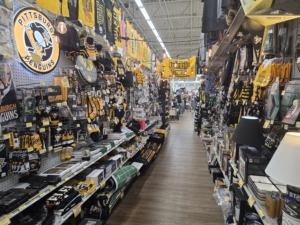
A Pittsburgh Pirates hat doesn’t have to travel far to find a buyer in western Pennsylvania. At Ambridge Do it Best Home Center, many such caps traveled much farther.
When owner David Strano posted a new licensed Pirates hat on social media last summer, the response was immediate. The store sold out within two days as messages and orders arrived from well beyond Ambridge—Strano’s store was shipping Bucco lids to customers in 25 states.
For Strano, those sales represent something bigger than one well-timed product post. They show what can happen when a local business understands its identity, gives people a reason to keep paying attention and then recognizes the moments when attention translates into business.
That approach runs throughout Ambridge Home Center’s presence on Facebook, Instagram and TikTok. The 55-employee family business posts several times a day, mixing products and promotions with employees, customers, community events, pets and plenty of humor. Some posts entertain. Others bring customers through the doors. One video has generated more than 1.5 million views.
Behind that steady stream of content is a deliberate strategy: Keep the store familiar, useful and engaging to the people it serves, then measure what resonates and adjust accordingly. That’s why social media is now an integral part of the more than four-decade-old family business’s customer connection—and it has earned Ambridge Do it Best Home Center the 2026 Beacon Award for Digital Excellence.
From Print to Posts
Strano grew up in the business his family started in the early 80s. His father remains company president, and Strano worked at the store through high school and college, learning different roles throughout the operation. His wife has since joined the business as well.
His introduction to social media came early. As a college student around 2005, Strano remembers Facebook when access was still limited to students at select colleges. He didn’t create a Facebook page for the business until about 2010, when the platform was beginning to reach a much broader audience.
What followed was no overnight success.
“It took six years and a lot of hard work,” Strano says. “There was a lot of blood, sweat and tears putting out good content on a daily basis.”
That daily commitment remains the foundation of Ambridge’s strategy.
“First and foremost, be consistent,” he says. “You can’t take a week off social media. It doesn’t work that way.”
Ambridge maintains a content calendar and divides responsibilities among a small team. Certain posts have regular slots. Mondays bring the week’s event calendar, including food trucks, classes and special events. Tuesdays feature the flavorof the week from a local doughnut business whose products Ambridge sells on Saturdays. Print promotions are carried onto the website and social channels.
Around those planned posts, the team leaves room for whatever happens inside the store.
“You have to have an agenda,” Strano says. “But you have to throw in the random posts, too.”
That can mean an employee birthday or one of several reels the team produces each week. Cashiers are trained to photograph the pets customers bring into the pet-friendly store and provide captions for social posts.
The result can be three or four posts in a day without the feed feeling like a repeating advertisement.
Give Them a Reason to Watch
Such variety is intentional. Strano has learned that customers quickly tune out a business that constantly tries to sell them something.
“People don’t want to be sold every single day,” he says. “They want to be part of you. They want to be engaged.”
He describes social media as a stage. Someone might be having a lousy day and encounter a funny Ambridge video that draws a laugh. Those moments might not immediately sell a product, but they give customers another reason to pay attention the next time Ambridge has something to say.

Some of its biggest hits have been remarkably simple. One video involving a pen tossed into a bucket has drawn more than 1.5 million views. Seasonal videos featuring an employee dressed as the Easter Bunny or the Grinch have taken off as well.
The store loops in customers, too. About once a month, Strano features longtime customers, and familiar community members sometimes appear in videos. The response has reached the point where customers contact the store asking if they can be in one.
“People get to know who the employees are,” Strano says. “It’s a face and a name.”
Ambridge’s annual Facebook pet contest demonstrates how effectively that relationship can work in the other direction. The contest, now about a decade old, has generated as many as 1,200 to 1,300 entries, with customers posting pictures of their four-legged friends. Strano says a contest can add 300 to 500 followers to the store’s social audience.
When a Post Rings the Register
Entertainment and community may keep people watching, but Strano also knows when it’s time to sell.
The trick is finding something worth talking about. Posting another familiar commodity usually won’t create urgency. A distinctive product arriving at precisely the right moment can. Those sales aren’t the core of Ambridge’s business, Strano says. They’re a bonus made possible by an audience that extends far beyond the store’s immediate market.
Digital promotion can have an even more direct local impact. When Ambridge added a black-and-gold dunk tank to its rental inventory, the store promoted it on social media. It went out about ten times its first two weeks.
“[Customers] wouldn’t find out about it any other way,” Strano says.
Ambridge measures those results alongside conventional social analytics. The team watches views and engagement, but Strano also tracks redemption of monthly coupons and promotions and watches what happens to sales after a product appears online.
Beyond attracting eyeballs, the Ambridge social media team evaluates whether people acted on posts.
A Digital Front Door
Ambridge’s website gives those customers another way into the business, offering online ordering, same-day pickup, rental information, weekly and monthly promotions, employment information and answers to common questions.
Strano says there’s more work ahead. With about 56,000 SKUs in the store, the website doesn’t yet represent everything Ambridge sells, and he sees opportunities to improve search visibility and expand e-commerce.
For now, the store typically receives five to 10 same-day pickup or ship-to-store orders per day. Strano sees the website and social media as pieces of an ongoing digital evolution rather than a finished project.

That willingness to keep changing extends back to the products on Ambridge’s shelves. WD-40, the Digital Beacon Award sponsor, has been part of the assortment since the business opened. What began with a hardware staple has grown into a dedicated automotive aisle carrying multiple WD-40 products, including specialty lubricants and penetrants.
The channels have changed. The underlying retail job hasn’t.
For Strano, digital media gives an independent business something especially valuable: the ability to tell customers who it is every day.
“I’m a single store. I don’t have the power of Walmart or Home Depot,” he says. “But I can continue to work hard and put out good content.”
That is also the advice he offers other independents: Post consistently, involve more than one employee, create a calendar, maintain a backlog of ideas and make digital communication a real responsibility rather than something squeezed in only when there’s time.
Most important, give people something original to remember.
“You want them reminded on a daily basis,” Strano says. “Put out who you are.”
The best measure of Ambridge Home Center’s success comes back to that Pittsburgh Pirates hat. Strano put something interesting in front of customers, they paid attention and two days later the hats were gone. Views and shares can tell him plenty, but the final score is what happens next.