
Q&A Thought Leadership: From Data to Decisions
Rundoo co-founder and CEO Nick Hershey weighs the practical uses of AI, the technology retailers should question and how automation could reshape store operations.
Technology companies often build products for the broadest possible market. Rundoo has taken a different route, focusing its point-of-sale platform on independent hardware, paint, lumber and other supply retailers and the particular demands of businesses serving both consumers and professional customers.
 Co-founded by CEO Nick Hershey and CTO Andrew Beckman, Rundoo has built its platform around the complexities of independent retail, including charge accounts, job accounts, special pricing and taxation, along with integrations connecting retailers with distributors, manufacturers and buying groups.
Hershey brings an unusual background to that work. Before entering retail technology, he conducted applied AI research at the Stanford Artificial Intelligence Laboratory. That experience gives him a perspective that reaches beyond point-of-sale technology at a time when artificial intelligence is rapidly moving into everyday business operations.
In this exclusive interview, Hardware Connection spoke with Hershey about what Rundoo has learned from independent retailers, how store technology is evolving and where he believes the industry and related tech could be headed.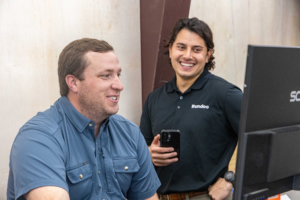
Hardware Connection: You’ve built Rundoo specifically around independent hardware and supply retailers rather than trying to create technology that serves the entire retail market. What have you learned about the independent channel that you didn’t understand when you started the company?
Nick Hershey: The biggest difference I see between independent supply retailers and general retailers is that the former sells to both businesses and consumers. Because independent supply stores serve contractors, farmers, schools, and local governments, they must offer charge accounts, special taxation, discounted pricing, job accounts and more. I did, however, know this coming in, and it was a large reason for starting Rundoo!
So to answer your question of something I didn’t fully appreciate: the critical role that distributors, manufacturers and buying co-operatives play. Rundoo has fully integrated or is in the process of integrating with dozens of distributors like Orgill and House-Hasson, manufacturers like Benjamin Moore and PPC and buying co-operatives like ALLPRO and Ace. Independent supply stores wouldn’t exist without these partners, and vice versa.
When you look across the independent stores Rundoo now works with, what technology trends are gaining traction—and which much-discussed trends do you think are getting ahead of what retailers actually need?
AI is the most astonishing.
We launched Dooey as an AI agent that has read and write access to Rundoo in late 2025. Today, over 90% of our clients use Dooey weekly, and over 50% use Dooey daily. The frequency and variety was surprising enough that we rebranded Rundoo’s tagline to “The AI-First POS for Independent Supply Stores” and we encourage all of our clients to “Try AI First” for workflows in their business.
On the flip side, we have seen declining usage of mobile computers in favor of simple Android devices. Mobile computers can cost thousands of dollars and be clunky to use, whereas a cheap Android phone can be a few hundred dollars and be much more flexible.
For independent hardware retailers, where is AI already producing measurable value, and where should retailers remain skeptical of the hype?
We see a tremendous variety in ways AI is already producing measurable value. To help retailers learn, we teach the AAA framework. Each “A” represents a level, and we see retailers move down the path as their comfort grows.
The first A is analyze. This is retailers asking questions of their data: how is each department doing compared to last year? Which hours should I change my staffing? Which customers would benefit from outreach? And so on.
The second A is act. This is retailers having Dooey take action: update my costs based on this PDF a vendor sent me, build an order based on these show discounts, and so on.
The final A is automate. This is retailers running a Dooey prompt on some schedule without a human in the loop: every Thursday, generate a purchase order for this vendor, assign any customers created each day to a sales rep, every month compare my products to the local big box store and so on.
As for skepticism, I caution clients on using AI to write individualized sales or marketing emails. Regulations have led AI models to have a pretty distinct voice, and many consumers have a knee jerk negative reaction to anything that feels AI-written. At a minimum, I recommend any language that goes out the door to be read by a human if it was written with AI.
Independent retailers have access to more business data than they did even a few years ago, but having data and knowing what to do with it are very different things. Where do you see retailers leaving the most value on the table with the information they already have?
The premise of your statement has been true since retailers started adopting point-of-sale systems in the 80s, 90s and 2000s. That is, independent retailers have had more business data than they could reasonably analyze.
This moment in time is magical because AI models immediately solve that problem. Whenever a client goes live on Rundoo, they have one default routine that Rundoo sets up: a daily summary. The prompt is essentially: “Based on everything that happened today, what are the three most important things for the owner to know?”
We have seen this identify a whole bunch of ideas, and probably the most consistent ROI comes from identifying mis-priced products.
Investing in technology can be expensive, disruptive and intimidating, especially for a retailer that has used the same system for years. What should an owner evaluate before making that decision, and what questions should they be asking a prospective technology provider that retailers frequently overlook?
My biggest recommendation is to make a plan.
Switching POS providers is a big deal. Before you sign a contract, map out the journey from today to the go-live day.
Bold prediction time: Five years from now, what will technology allow an independent hardware retailer to do routinely that would seem remarkable—or perhaps unrealistic—to the average store owner today
Oh gosh, things are changing so rapidly in technology that I have no idea. I’ll take a stab, but don’t rely on it for anything.
For independent supply stores, I view technology as a way to remove time spent on everything other than customer service.
The 2026 foundation models can remove a lot of the digital non-service work: decisions around staffing, pricing, inventory.
Perhaps the 2031 models will remove a lot of the physical non-service work: receiving products, counting inventory, transferring between stores. I used to do AI research as part of the Stanford AI Lab, and a number of my former collaborators have shifted their focus to robotics.
The thing that I hypothesize will remain is service. Good service didn’t lose its value with the internet, and I doubt it will lose its value with AI.