
From Niche to Normal — Fairfax Lumber & Hardware’s Fairfax Green Program

In California, Fairfax Lumber & Hardware’s Fairfax Green program shows how product selection and pricing alignment turn environmental focus into everyday retail results.
Two decades ago, Fairfax Lumber & Hardware in Fairfax, Calif., built its Fairfax Green program around a straightforward idea: Align its product selection with the way building science was evolving and use that alignment to boost business. Fairfax Green, developed in 2005 and launched a year later, focused early on energy efficiency, resource conservation and indoor air quality—areas that were beginning to shape both product development and customer expectations.

“We started the program as a way to grow our business,” says Augie Venezia, president of Fairfax Lumber, an employee-owned company about 25 miles north of San Francisco. “At that time building science was experimenting with different materials to increase energy efficiency and resource conservation.”
Those priorities continue to guide how Fairfax Lumber evaluates products today.
“We look for no CA Proposition 65–listed ingredients, no outgassing, made with natural ingredients and hopefully locally sourced,” Venezia says, referring to a 1986 law that seeks to combat chemicals in drinking water.
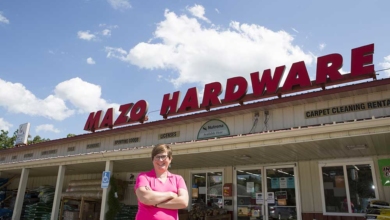
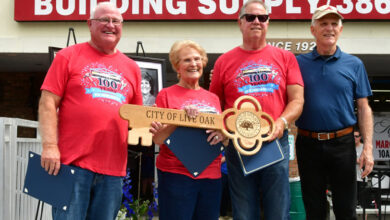
A Hardware Connection Century Club retailer founded in 1912, Fairfax Lumber & Hardware has been a community fixture for decades, and Fairfax Green has influenced its merchandising strategy across multiple categories. Over time, that influence has shifted from a distinct program to a set of embedded practices that shape everyday decisions.

Sustainability Through Product Selection
Fairfax Green shows up throughout the store’s assortment. Rather than relying on heavy in-store messaging, the program operates through product choices and staff guidance.
Venezia notes that price differences between environmentally conscious products and traditional options have narrowed over time, making it easier to integrate these items across categories.
“Environmentally friendly product prices compete with traditional product prices very well,” he says. “Price differences are marginal. Everything is expensive.”
That shift has helped expand the reach of the program, particularly in lawn-and-garden, the category that has seen the most growth tied to Fairfax Green, Venezia says, with many traditional products replaced by alternatives that align with the store’s criteria. “The biggest growth has been in garden products, to the point where a lot of traditional products have been discontinued here.”
Beyond lawn-and-garden, Fairfax Green includes a wide range of products linked to energy use, water efficiency and indoor air quality: LED lighting, occupancy sensors, humidity-sensing switches, ventilators, water-efficient plumbing fixtures and high-efficiency furnace filters, along with cleaning supplies that meet the store’s standards.
In lumber, sustainability has become part of the baseline. Venezia points to widespread adoption of certification standards. “Almost all our inventory is SFI-certified,” he says. “FSC certification is too cumbersome and expensive to maintain.” (SFI—Sustainable Forestry Initiative—and FSC—Forest Stewardship Council—certifications indicate that wood and building materials come from responsibly managed forests that adhere to environmental, social and sustainability standards.)

Customer Behavior and In-Store Conversations
Demand for sustainable products varies by category. Venezia says that while some consumers actively seek green alternatives, most interactions still depend on staff introducing options and explaining their benefits.
“Very few customers actually ask for alternatives,” he says. “Those who do, do so for garden products.”
Education plays a role in those discussions, though the approach remains straightforward. Rather than detailed technical explanations, Fairfax Lumber focuses on clear, concise messaging tied to health and performance.
“All it takes is a simple explanation such as ‘This product has no ingredients in it that cause cancer, birth defects and other reproductive harm,’ ” Venezia says.
Such simplicity reflects broader changes in customer priorities. Venezia notes that sustainability is no longer a primary driver for many shoppers, whose attention is influenced by a range of economic and social concerns.
AN Evolving Role Within the Business
Fairfax Green has been a key factor in shaping Fairfax Lumber & Hardware’s identity, though its role has changed over time. Today, the store emphasizes knowledgeable staff and solutions-based merchandising, with sustainability integrated into the broader approach.
That evolution reflects a wider industry shift, as practices tied to energy efficiency, indoor air quality and resource conservation have become more common across product categories. For Fairfax Lumber, the program continues to inform business decisions, even as it operates alongside other priorities.
For retailers considering a similar approach, Venezia points to the importance of understanding the fundamentals of their market and operating environment.
Fairfax Green began as a way to align with emerging trends in building science and create a clearer path for growth. Now, two decades later, it remains part of how Fairfax Lumber selects products, guides customers and defines its place in the market.